Invoice the same clients again, and see what changed.
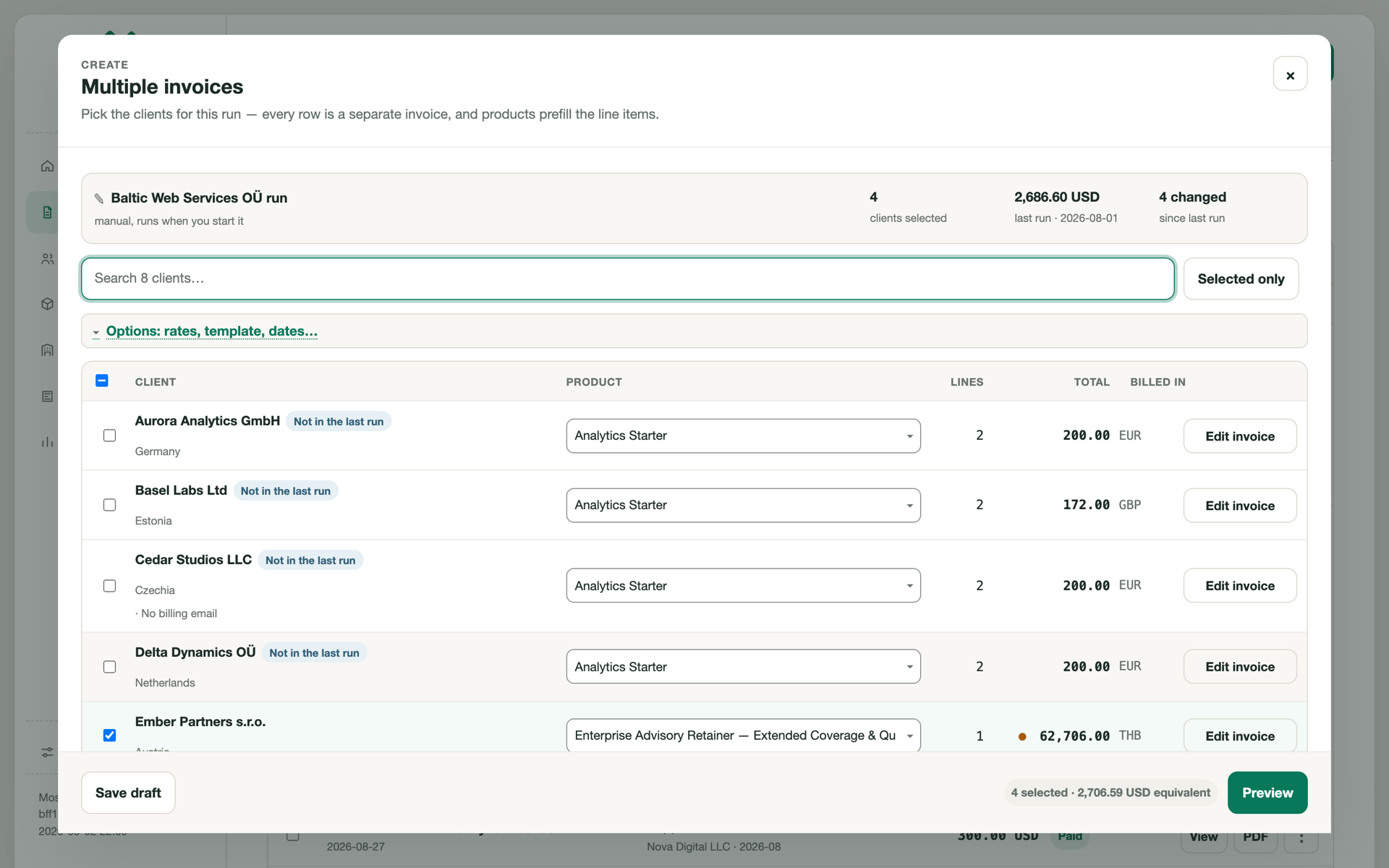
Re-open last month's run and the drafts are already there. The ones that moved are marked: a new price, a different service, a client who was not on the last run. Fix those, issue the set. Nothing is numbered until you say so.
Not open yet. One email when it is, and nothing else.
MostlySame Invoices is invoicing software for people who bill the same clients every month. It builds a run from a saved client list, shows what changed since the last run, and issues the set. It does not process payments and is not accounting software.
How a run works
Four steps, and the third one is the point.
- 1
Set up once
Your organization, your clients, and the things you bill for.
- 2
Build the run
Pick a saved client list, or last month's run. The drafts are already filled in.
- 3
Look at what changed
Every document is marked against the last run, with the difference in money.
- 4
Fix the exceptions, then issue
Correct the few that moved. Numbers are reserved at Issue, not before. One action issues the set.
The composer
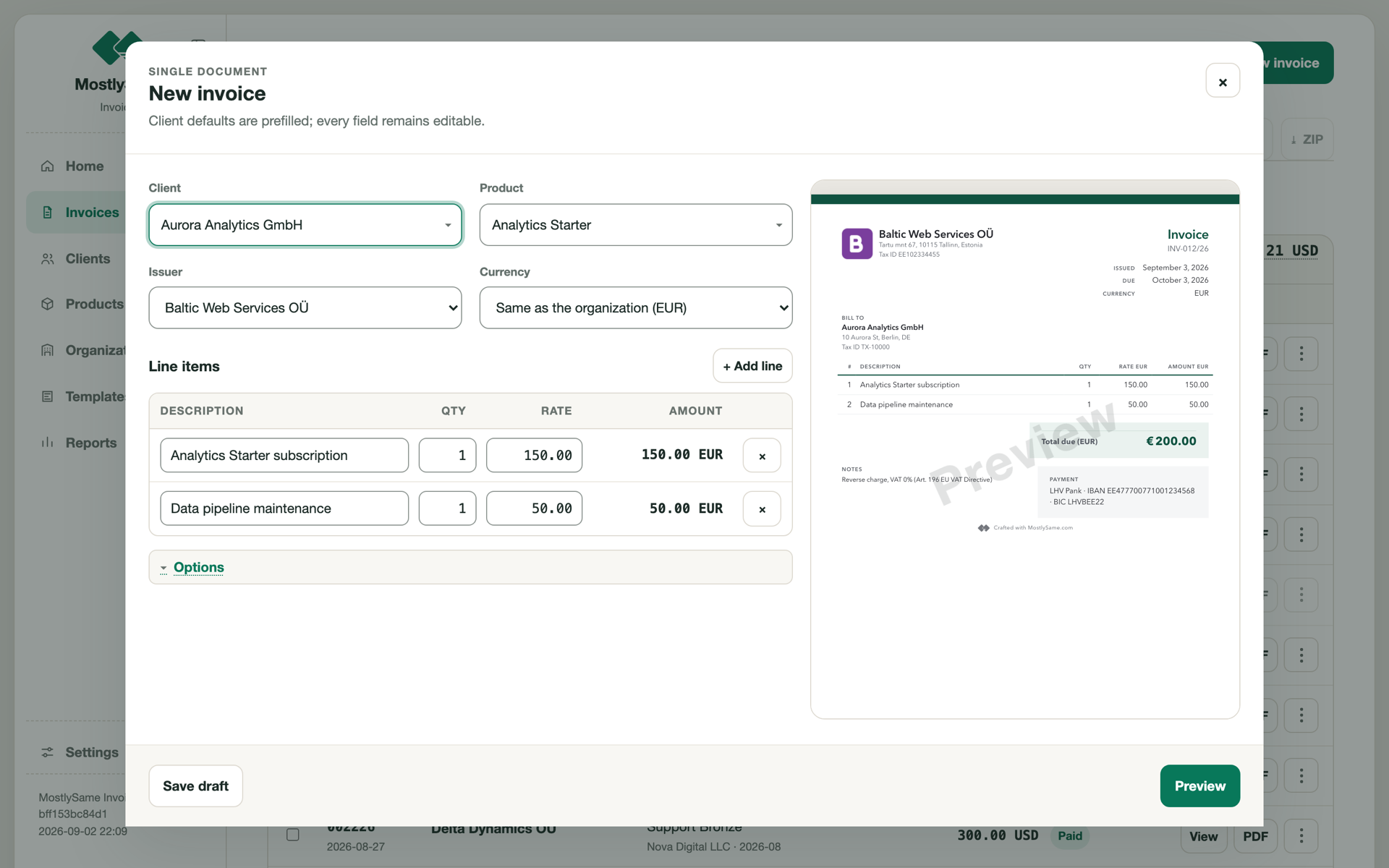
One document, and the real thing beside it.
Client, product, issuer, currency and line items are prefilled and all of them stay editable. The preview is the document itself, before an invoice number is used.
What changed
Forty invoices. Three of them moved.
Every document in a run carries its own mark against the last one, so the work is the exceptions rather than the list.
| Mark | What it means |
|---|---|
| Different product | A different service is billed this time. Naming it is the headline; the old figure rides along in the same line. |
| Total changed | The figure moved since the last run, and the difference is shown in money. |
| Not in the last run | On the list this run, not on the last one. |
An ad-hoc run has nothing to compare against, and says so instead of pretending.
Issued is issued
Once a document is issued, it stops moving.
- Issued invoices cannot be edited. Not by you, not by us.
- Numbers are reserved at Issue and never reused.
- Voiding reverses the money and keeps the number and the files.
- Every document keeps the organization, client and exchange-rate context it was issued with. Change every rate afterwards and a regenerated PDF still shows what you issued.
- A closed month rejects new invoices dated inside it.
- Every significant action lands in an append-only record you can read. Append-only by database grant, not by policy.
Money, said exactly
Four currencies, one figure, and a note that reconciles.
$ € £ ฿
USD, EUR, GBP and THB. Every report and run total is one USD figure. Foreign amounts appear in a breakdown note that reconciles exactly, never as a second column.
Your rates, your rule
Rates come from live marked-up quotes or from your own stored book. You choose which, and it is one rule for the whole organization.
Collected means arrived
Collected counts the payments that arrived in the window. Issued counts documents. They do not add up to each other, and the screen says so.
Decimal, two places
Money is decimal, two places, rounded half up. Never a float.
What this is not
The wrong tool, said plainly.
MostlySame Invoices does not keep your books, and it does not process or hold payments. It makes the documents. We never touch the money.